Finding the right screwdriver antenna can be a real challenge, especially when you want something reliable, versatile, and easy to use. You’re not alone—many people struggle to balance performance with convenience in their antenna choice.
That’s why we’ve put together a roundup of the best screwdriver antennas for 2026 to help you make an informed decision.
For 2026, consider the RHM12 Diamond Antenna if you want precise manual tuning and portability.
The Harvest HD-330 offers broad multi-band coverage (3.5 to 30/50 MHz) with easy installation.
If you prefer hassle-free operation, the Yaesu ATAS-120A’s motorized tuning covers HF to UHF bands automatically.
Each handles outdoor use well and suits various power levels.
Want to investigate which features best fit your radio needs?
| Image | Name | Editor's Rating | Price |
|---|---|---|---|

|
Diamond Antenna RHM12 Diamond Antenna po…
|
|
|

|
Generic Harvest HD-330 Multi-Band 3.5~30…
|
|
|

|
Yaesu ATAS-120A 40 Meter through 70cm Au…
|
|
RHM12 Diamond Antenna portable screwdriver type antenna RHM12
- The Diamond RHM12 portable screwdriver type antenna is…
- Featuring an adjustable coil design, this antenna enables…
- Built for portability and field use, the RHM12 antenna…
The RHM12 Diamond Antenna is a versatile solution for amateur radio enthusiasts who need reliable HF frequency performance on the go. Its portable screwdriver design allows quick and precise manual tuning, making it easy to adjust to different bands without complicated setups. This adaptability helps operators maintain clear communication in varied environments.
Built with durability in mind, the RHM12 withstands outdoor conditions and travel stresses while maintaining stable operation. Its compact size simplifies transport and storage, ideal for users who work in mobile or temporary locations. The antenna’s adjustable coil design ensures that frequency alignment is accurate, enhancing signal quality.
Maintenance is straightforward, with manual tuning requiring some attention but no specialized tools. While the screwdriver mechanism may be more delicate than fixed antennas, careful handling ensures longevity. Performance depends on environmental factors and setup, so operators should be prepared to fine-tune for best results.
Overall, this antenna balances flexibility and efficiency, providing dependable HF operation in non-permanent settings. Its combination of portability and manual tuning capability makes it a practical choice for field communication needs.
Best for: Amateur radio operators needing a portable, adjustable antenna for flexible HF frequency operation in mobile or temporary setups.
What we like:
- Precise manual tuning with adjustable coil for multiple frequency bands
- Durable construction suited for outdoor and travel use
- Compact and lightweight design enhances portability
- Suitable for mobile and temporary radio operations
Specification:
| Specification | Description |
|---|---|
| Model | RHM12 Diamond Antenna |
| Antenna Type | Portable screwdriver type |
| Frequency Range | HF bands (multiple adjustable frequencies) |
| Tuning Mechanism | Manual adjustable coil |
| Durability | Weather-resistant, rugged construction |
| Dimensions | Compact, easy to transport |
| Intended Use | Mobile, temporary, and portable HF setups |
| Weight | Lightweight for easy carrying |
Harvest HD-330 Multi-Band 3.5~30/50MHz Screwdriver Mobile Antenna
- Frequency:3.5~30/50MHz
- Power:200W
- Height: 49.000 – 73 Inch
The Harvest HD-330 Multi-Band Screwdriver Mobile Antenna offers a practical solution for radio operators who require broad frequency coverage in a compact, mobile design. Its range from 3.5 to 30/50 MHz allows users to access multiple bands without changing equipment, enhancing communication flexibility on the go. This versatility is especially useful for amateur enthusiasts and professionals who need reliable signal access across different frequencies.
Designed for ease of installation, the antenna connects via a standard SO-239 connector and runs on a 12V DC power supply, making it compatible with most mobile radio setups. Its adjustable height, ranging from 49 to 73 inches, enables fine-tuning for optimal signal clarity based on the operating environment. This feature supports consistent performance whether stationary or in motion.
Maintenance is straightforward, as the antenna’s robust build can withstand typical outdoor conditions with minimal upkeep. However, users should be comfortable with screwdriver antenna tuning to fully benefit from its adjustable features. The HD-330 is engineered to handle up to 200W power, meeting the demands of various transmission requirements without compromising durability.
This antenna strikes a balance between portability and performance, making it a dependable choice for those needing multi-band mobile operation with precise control over signal quality.
Best for: Amateur and professional radio operators seeking a versatile, multi-band mobile antenna with reliable performance and adjustable height.
What We Like:
- Wide frequency coverage from 3.5 to 30/50 MHz enables flexible use.
- Supports up to 200W power for diverse transmission needs.
- Adjustable height between 49 and 73 inches allows signal optimization.
- Simple installation using a standard SO-239 connector.
- Durable design suited for mobile and outdoor environments.
Specification:
| Specification Title | Detailed Description |
|---|---|
| Frequency Range | 3.5 to 30/50 MHz |
| Power Handling | Up to 200 Watts |
| Adjustable Height | 49 to 73 inches |
| Connector Type | SO-239 |
| Power Supply Requirements | 12V DC |
| Antenna Type | Screwdriver Mobile Antenna |
| Release Date | July 2023 |
| Intended Use | Mobile amateur and professional radio operation |
Yaesu ATAS-120A Motorized Auto Tune HF/VHF/UHF Antenna
- For The Following Yaesu Amateur Radio Models – FT-857D,…
- Covers HF thru UHF, Auto Self-Tuning, motorized Transceiver…
- Designed for mobile (automotive) use, and Requires an…
The Yaesu ATAS-120A Motorized Auto Tune Antenna offers a seamless solution for operators needing reliable coverage from HF through UHF bands. Designed to automatically adjust its length via a motorized trombone section, it fine-tunes itself at the push of a button on compatible Yaesu radios. This eliminates the hassle of manual tuning, saving time and effort during mobile operations.
Extending to about five feet, the antenna is well suited for automotive use, providing broad frequency coverage from 40 meters up to 450 MHz. Its robust design ensures consistent performance across multiple bands without the need to switch antennas or adjust settings manually. This adaptability makes it ideal for operators who require flexibility on the move.
Maintenance is straightforward as the antenna’s motorized tuning reduces wear from manual adjustments. However, users need to install a separate mount and coaxial cable, which allows for customization based on vehicle type and installation preferences. The antenna’s compatibility is limited to specific Yaesu transceivers, ensuring optimized integration but restricting use with other brands.
Overall, the ATAS-120A improves the mobile amateur radio experience by providing automatic, multi-band tuning in a compact, durable package. Its design balances ease of use with professional functionality, making it a dependable choice for mobile operators.
Best for: Amateur radio enthusiasts seeking a versatile, self-tuning mobile antenna compatible with Yaesu HF/VHF/UHF radios.
What We Like:
- Wide frequency range covering HF to UHF bands (40m to 450 MHz)
- Motorized trombone section enables automatic tuning at the push of a button
- Designed specifically for integration with popular Yaesu transceivers
- Compact size suitable for mobile vehicle installations
- Simplifies operation by eliminating manual antenna tuning
Specification:
| Specification Title | Detailed Description |
|---|---|
| Frequency Coverage | 7 MHz (40 meters) to 450 MHz |
| Antenna Type | Motorized Auto Tune Mobile Antenna |
| Antenna Length (Extended) | Approximately 5 feet (1.5 meters) |
| Tuning Method | Motorized trombone section controlled via Yaesu transceiver |
| Compatible Radios | Yaesu FT-991A, FT-857D, and other compatible models |
| Mounting Requirements | Separate mobile antenna mount and coax cable required |
| Intended Use | Mobile automotive HF/VHF/UHF amateur radio operations |
| Maintenance | Minimal; motorized tuning reduces manual wear |
Factors to Consider When Choosing a Screwdriver Antenna
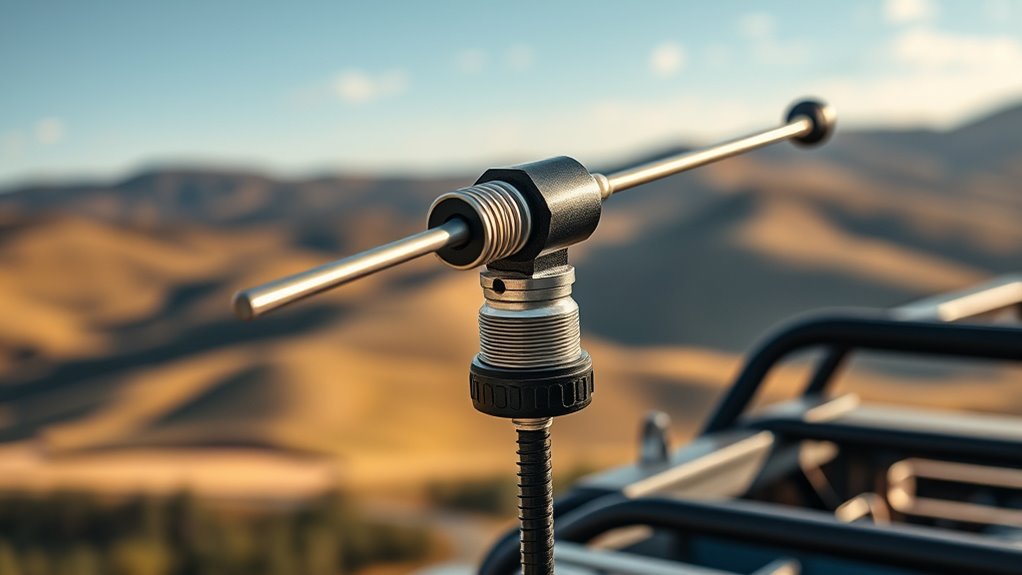
When you’re picking out a screwdriver antenna, the first thing to look at is its frequency range coverage — you want to make sure it matches your communication needs. Next up, think about the power handling capacity and the type of tuning mechanism, as these play a big role in keeping your performance reliable.
Also, don’t overlook portability and size; you want something that fits well with your setup and is easy to handle. And of course, the build quality matters a lot if you want the antenna to last over time without any hiccups.
Frequency Range Coverage
Although choosing a screwdriver antenna might seem straightforward, paying close attention to its frequency range coverage guarantees you get the versatility you need for various amateur radio bands. You want an antenna that covers the specific frequencies you plan to operate on, ensuring clear signals and ideal performance.
Some models support broad ranges, like 3.5 to 30 or even 50 MHz, letting you switch between bands without swapping antennas. This multi-band capability improves convenience and adaptability, especially if you use different amateur radio applications.
A wider frequency range lets you communicate across HF to UHF frequencies effectively, expanding your reach. So, focus on selecting an antenna with frequency coverage that matches your operating needs for the best results.
Power Handling Capacity
Matching your antenna’s frequency range with your radio gear is important, but so is guaranteeing it can handle the power you plan to transmit. The power handling capacity of a screwdriver antenna dictates how much power it can safely manage without damage or performance loss. Most models support between 100W and 200W, though some built with robust materials can handle higher levels.
You need to match your antenna’s rating with your radio’s output to avoid overheating or failure. Choosing an antenna with adequate power capacity not only protects your equipment but also boosts signal quality and range when operating at higher power. Always check the manufacturer’s specifications for maximum power to guarantee reliable and efficient performance during your transmissions.
Tuning Mechanism Type
Choosing the right tuning mechanism type is key to getting the best performance from your screwdriver antenna. Manual tuning mechanisms let you quickly adjust settings for different frequencies, giving you flexibility when conditions change.
If you want convenience, automatic tuning systems, like motorized options, adjust the antenna length based on the selected frequency. This makes band shifts seamless and hassle-free.
Keep in mind that the efficiency of the tuning mechanism directly impacts signal quality, especially in challenging environments. You’ll also want a system that’s durable and easy to adjust, particularly if you use the antenna outdoors or move it frequently.
Portability and Size
When you plan to take your screwdriver antenna into the field, its portability and size become critical factors. You’ll want a compact, lightweight design that’s easy to transport and store during field operations.
Choosing an antenna that easily adjusts in height or collapses lets you adapt quickly to different environments. This flexibility makes setup and relocation hassle-free, reducing physical strain.
Furthermore, a portable antenna should be simple to install and dismantle, streamlining your workflow and saving time. Keeping these aspects in mind guarantees you pick an antenna that won’t slow you down in the field. That way, you can focus on your radio work without struggling with bulky or cumbersome gear.
Durability and Build Quality
Because you’ll often use screwdriver antennas outdoors and on the move, durability and build quality play an essential role in their effectiveness. You need an antenna built with high-grade metals and weather-resistant coatings to withstand varied environments and frequent travel. A robust construction lets you adjust the antenna repeatedly without losing signal quality or performance.
It’s vital that adjustable coils and secure mounts are crafted to maintain stability across different frequency bands and conditions. While you want a lightweight design for easy transport, it shouldn’t sacrifice sturdiness. Balancing portability with resilience guarantees your antenna lasts and performs reliably during field operations.
Choosing a screwdriver antenna with durable components means you won’t have to worry about failures or degraded signals when you need them most. So, it’s definitely worth investing in quality materials and solid craftsmanship to keep your setup dependable out there.
Compatibility With Radios
One of the most important factors to evaluate with screwdriver antennas is how well they match your radio equipment. You’ll want to verify the antenna supports your specific radio models, as connector types and tuning needs can vary.
Compatibility directly impacts performance. Some antennas work best with certain brands, boosting tuning speed and signal clarity. Always check the antenna’s frequency range to validate it covers your operating bands, since many are optimized for particular frequencies.
Features like auto-tuning can simplify your setup if your radio supports it. Don’t forget to take into account any extra gear the antenna might need, such as specialized mounts or coaxial cables, to guarantee smooth integration and top performance with your radio system.
Frequently Asked Questions
How Do Screwdriver Antennas Compare to Traditional Whip Antennas?
Screwdriver antennas offer you adjustable length, letting you tune frequencies more precisely than traditional whip antennas. While whips are simple and reliable, screwdrivers provide better performance across various bands, especially for ham radio.
You’ll appreciate their versatility and superior signal quality, though they require power and more maintenance. If you want flexibility and upgraded reception, screwdriver antennas are a smarter choice over fixed-length whips.
Can Screwdriver Antennas Be Used Indoors Effectively?
You can use screwdriver antennas indoors effectively, but expect some signal loss. Studies show indoor antenna performance can drop by up to 30% due to walls and interference. Screwdriver antennas help by letting you adjust frequency and length, improving reception even inside.
Just position it near a window or away from metal objects to maximize signal strength. With a bit of tweaking, you’ll get reliable indoor reception without much hassle. It’s really about finding that sweet spot in your space. Give it a try and see how much better your signal gets!
What Maintenance Is Required for Screwdriver Antennas?
You’ll want to regularly check your screwdriver antenna for corrosion, especially around connectors and joints. Keep the antenna clean by wiping it down with a damp cloth to remove dirt and debris. Make certain all mounting hardware is tight to avoid vibrations.
Occasionally, inspect the motor and control system to guarantee smooth operation. Doing these simple maintenance tasks will keep your antenna performing reliably and extend its lifespan. It’s really not that hard once you get into a routine!
Are Screwdriver Antennas Compatible With All Radio Brands?
Screwdriver antennas aren’t universally compatible with all radio brands, but many models are designed to work with popular radios. You’ll want to check the antenna’s specifications and your radio’s requirements before buying. Compatibility often depends on the radio’s frequency range, power output, and connector type.
If you pick the right screwdriver antenna, you’ll enjoy seamless integration and better performance. Always verify compatibility to avoid issues. It’s a good idea to double-check before making your purchase to save yourself headaches later.
How Does Antenna Tuning Affect Signal Clarity?
You want clearer signals, stronger reception, and less interference. Antenna tuning directly affects signal clarity by matching the antenna’s frequency to your radio’s operating frequency. When you tune correctly, you minimize signal loss and reduce noise, ensuring crisp audio and reliable communication.
If you neglect tuning, you’ll face weak signals, static, and dropped transmissions. So, take control, adjust your antenna, and enjoy clearer conversations every time you transmit. It’s really that simple!
Conclusion
Choosing the perfect screwdriver antenna is like tuning a fine instrument. You want precision, reliability, and versatility in every note.
Whether you pick the RHM12 Diamond for portability, the Harvest HD-330 for multi-band power, or the Yaesu ATAS-120A for seamless auto-tuning, you’ll be ready to conquer the airwaves. So, gear up and let your signal soar like a hawk, cutting through the noise with clarity and strength wherever your adventures take you.
When it comes to selecting the best screwdriver antenna, these top choices will ensure your communication is crisp and dependable every time.